top of page

August 12, 2026 – Solar eclipse, Milky Way, and Perseids over the Palatinate Forest

  • Writer: Niko Benas
    Niko Benas
  • Aug 14
  • 3 min read

On August 12, 2026, the Lindelbrunn castle ruins (49.144528, 7.896444) became the setting for a special celestial event: a partial solar eclipse that bathed the scene in extraordinary light during the early evening.

Situated at an elevation of approximately 440 meters, the ruins offer a sweeping panoramic view. They are the remains of a medieval rock castle located near Vorderweidenthal in the Southern Wine Route district of Rhineland-Palatinate.

In this region, the eclipse reached its peak around 8:15 PM; subsequently, the moon's coverage of the sun began to recede until the partial eclipse ended at approximately 8:51 PM.

As night fell, the photographic journey continued, yielding images of the Milky Way and the Perseids—an atmospheric transition from the moon's shadow to the starry sky.


This blog follows the chronological progression of these events, deliberately limiting itself to brief sentences describing the action, accompanied by the corresponding photos. The result is less a detailed report than a photographic journey through time—from the moon’s first contact with the sun to the starry night sky over Lindelbrunn.


5:25 PM: Arrival at the hiking car park and initial photos taken below the Lindelbrunn castle ruins.
6:11 PM: About an hour remains until the partial eclipse begins.
7:21 PM: Effectively the moment of first contact. At this time, the Moon is just beginning to touch the edge of the Sun. The local eclipse begins in the region at 7:21 PM.
8:04 PM: The Moon covers approximately 71% of the solar disk.
8:09 PM: The Moon covers approximately 82% of the solar disk. Spectators watch the natural spectacle spellbound through solar eclipse glasses and special filters.
8:11 PM: The Moon covers approximately 86% of the solar disk's surface area. The partial solar eclipse bathed the Palatinate Forest in an unusually subdued, leaden-looking evening light.
8:14 PM: Moon covering approximately 89% of the solar disk. The peak is nearly reached.
8:37 PM: Geometric calculation indicates the Moon is covering approximately 42% of the solar disk.
8:38 PM: At the castle ruins, the Moon is now covering about 39% of the solar disk.
8:41 PM: Moon covering about 32% of the solar disk. By this time, the eclipse was already clearly subsiding.
8:43 PM: Approx. 28% coverage of the Sun; the local eclipse is already well past its peak.
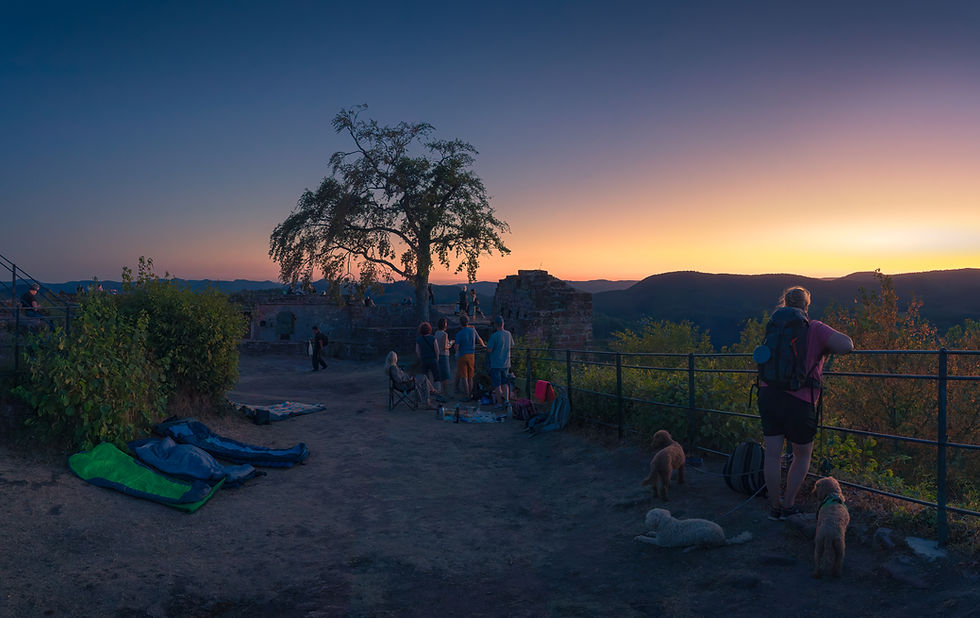
9:19 PM: The partial solar eclipse has already ended by this time. The sun set at approximately 8:51 PM. The transition between the golden hour and the blue hour is clearly visible. The warm, golden-orange-red light gives way to a deep, cool blue.
10:54 PM: A view towards the radiant of the Perseids. During the evening and night hours, this center is located in the northeastern to eastern sky and rises higher as the night progresses. Light pollution caused by nearby human settlements is clearly visible—specifically the glows of light from Annweiler and the wider Landau area—as well as the presence of various satellites in the sky.
11:53 PM: The summer Milky Way already arches impressively across the night sky; meanwhile, the bright region of the galactic center in the southwest is slowly setting, and in the northeast, the Perseid radiant is increasingly moving into position for the upcoming night of shooting stars. Parallel to the Milky Way, a meteor streaks into the atmosphere with great force and burns up. To its left, a smaller shooting star can be seen.
12:49 AM: A tree grows in the middle of the castle courtyard today, reminiscent of the legendary linden tree by the castle well—from which Lindelbrunn Castle presumably took its name—though whether it is truly a direct descendant of that original tree remains a mystery. Illuminated by light, it features in the final shot of this eventful evening of photography—an experience that will undoubtedly remain unforgettable. The encounter with three other very pleasant amateur photographers was, in itself, a truly enriching experience. A bright streak across the dark night sky reveals that a Perseid meteor has just burned up.


Comments


Commenting on this post isn't available anymore. Contact the site owner for more info.

Niko Benas Photo-Impulse ©  Romantic, mystical and dreamy landscape photography. Offering private workshops and calendars.

All content and photographs © 2026 Niko Benas Photo-Impulse - niko.benas@arcor.de
 

  • Facebook
  • Instagram
bottom of page