
.png)
September 12, 2026: Ireland’s Wild North Through the Lens: A Photo Journey to 10 Magical Locations

The north of Ireland—referring generally to both the political entity of Northern Ireland and the geographically northern province of Ulster—can be characterized as a region of dramatic contrasts, profound historical upheavals, and breathtaking natural beauty.
Below is my personal top-ten selection of favorite photo spots—entirely subjective and making no claim to be exhaustive:
No. 10: Assaranca Waterfall and Maghera Beach
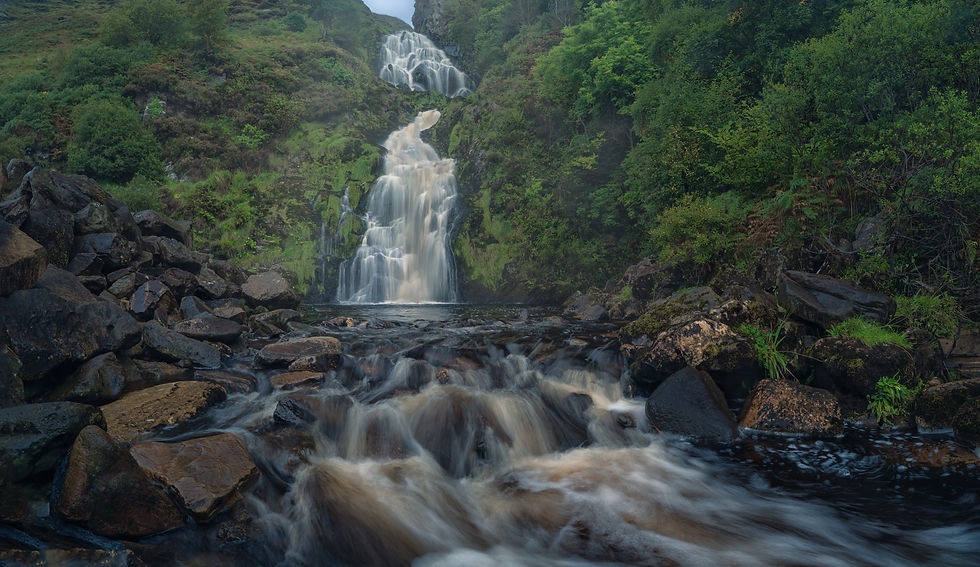
With its broad cascade tumbling over the rocks, the Assaranca Waterfall near Ardara is one of Donegal’s most atmospheric natural sights.
There is a small roadside parking area right at the approach, offering a good view of the waterfall (54.758510, -8.513714).
A short, easy path leads from the parking area down to the base of the waterfall—though the ground can be slippery depending on the weather.
The moss-covered rocks, the cascading water, and the wild, unspoiled surroundings make for a particularly captivating scene.
For photographers, a visit is especially rewarding during or after rainfall, when the waterfall appears particularly powerful.
A short, easy path leads from the parking area down to the base of the waterfall—though the ground can be slippery depending on the weather.
The moss-covered rocks, the cascading water, and the wild, unspoiled surroundings make for a particularly captivating scene.
For photographers, a visit is especially rewarding during or after rainfall, when the waterfall appears particularly powerful.

Just a three-minute drive to the west lies Maghera Beach on the Donegal coast. It captivates visitors with its golden sands, dramatic cliffs, and numerous sea-sculpted caves—a sight that is particularly impressive at low tide.
At the western end of the beach, there are over 20 caves, along with 8 rock arches and 5 tunnels.

The official (paid) car park is located directly above the beach, making it an ideal starting point for a photography tour.
A short footpath leads down from the car park (54.763241, -8.527891) to the beach, allowing you to reach the location quickly (54.766788, -8.528766).
For photographers, the caves, rock formations, and expansive bay offer a wealth of compelling foreground elements.
The combination of low-angle sunlight and changeable Irish weather creates particularly atmospheric landscape shots.

No. 9: Glenoe Waterfall
Located in County Antrim, Glenoe Waterfall cascades roughly nine meters down dark rocks into a densely wooded, enchanting gorge—a particularly atmospheric sight after rainfall.
Two small parking areas are available along Waterfall Road (B99), providing direct access to the waterfall (54.800114, -5.832363).

From the parking area, a short path leads through the woods and up a few steps to a viewing bridge; the waterfall is reached after just 100 meters.
Additional steps and paths around the gorge offer various vantage points to view the cascades and the lush greenery.
Photographers might particularly enjoy using long exposure times to capture the water flowing over the mossy rocks, creating a soft, silky effect.

No. 8: Dunlewey Church and The Wooden Bridge
Dunlewey Church in County Donegal is a small, romantic grey-stone ruin set against the dramatic backdrop of Mount Errigal and the Derryveagh Mountains.
If parking is unavailable at the small lot right by the church (55.019373, -8.111044), the Dunlewey Lakeside Centre serves as a suitable starting point, offering parking facilities in the immediate vicinity (55.025452, -8.148292).

A short footpath leads from there along Dunlewy Lough to the church, making the subject easily accessible without a strenuous hike.
The combination of weathered masonry, the dark lake, and the rugged mountains in the background is particularly striking.
When the sun is low or mystical fog rolls in, the scene captures the quintessential rugged atmosphere of Ireland's northwest.

A walk of a few minutes down the road brings you to a picturesque and secluded spot. A bridge that leads to nowhere...
Although built of stone, it is known as "the wooden bridge"—apparently due to its original appearance.
It was originally intended to serve as a path to the priest's residence, but the route became unnecessary after he was assigned a new post and moved away.
From there, you can enjoy a magnificent view of the Poisoned Valley and Mount Errigale—at 751 meters, the highest mountain in County Donegal, Ireland.

No. 7: Ballintoy Harbour, Sandy Port, and Elephant Rock
Located on the Causeway Coast, Ballintoy Harbour captivates visitors with its rugged basalt cliffs, small rocky islets, turquoise waters, and dramatic, windswept coastal scenery.
A free car park (55.244050, -6.369453) located right by the harbour serves as an ideal starting point for a photography tour.

From there, it is just a short walk down to the small harbour basin and the striking rock formations.
The contrasting textures of the black rocks and the shifting light over the Atlantic are particularly appealing.
In rough seas, under cloudy skies, or at sunrise, Ballintoy Harbour and its surroundings reveal a particularly wild and photogenic side.

The hidden beach (also known as "Sandy Port") can be reached via a short walk from the harbor along Harbour Road (55.244057, -6.365998).
The harbor and coastline served as the setting for the "Iron Islands" in the series *Game of Thrones*.

Elephant Rock is a fascinating, elephant-shaped rock formation located just a short, scenic walk west of the harbor. According to local legend, it is the petrified remains of a real elephant that once fled into the sea to escape a volcanic eruption.
From the harbor, follow the coastal path on foot heading west (towards Whitepark Bay).
After crossing two fences and a short walk (approx. 15–20 minutes), you will reach the rock formation in the water (55.241927, -6.381097).

6th Place: Kinbane Castle
Kinbane Castle stands as an impressive ruin atop a narrow limestone headland on the Antrim Coast, offering spectacular views of the sea and the rugged shoreline.
Parking is available right next to the Kinbane Castle car park on Kinbane Road (55.227108, -6.291357), which offers the quickest access to the site.
A steep, partly uneven footpath—featuring steps—leads down from the car park to the castle ruins and the coast.

The weathered walls, striking limestone cliffs, and the view across the Atlantic to Rathlin Island are particularly photogenic.
At sunrise or under a dramatic, cloudy sky, the solitary ruin takes on a truly special atmosphere.

5th Place: The Dark Hedges
The Dark Hedges in Northern Ireland captivate visitors with an avenue lined by gnarled beech trees, creating an almost mystical atmosphere through the interplay of light and shadow.
The most convenient place to park is the designated paid coach and car park (55.138369, -6.383591), from which the site is just a short walk away.
The quickest way to reach the famous avenue of beech trees is via the signposted footpath leading directly from the car park.

Early morning—ideally just after sunrise—is particularly rewarding for photographers, as the avenue is still quiet and soft light filters through the trees.
To capture this distinctive atmosphere without the crowds, it is best to visit as early in the day as possible.

4th Place: Giant's Causeway
The Giant’s Causeway impresses with around 40,000 hexagonal basalt columns that jut out into the Atlantic like a colossal natural mosaic—a true highlight for landscape photographers (55.243681, -6.505330).
The paid Causeway Car Park near Innisfree Farm (55.234361, -6.511045) is a suitable place to park; a coastal path leads from there to the site, whereas the car park right next to the Visitor Centre is reserved for visitors who have booked the "Visitor Experience."

The quickest way to reach the coastal rock formations from the Visitor Centre is via the Blue Trail, which is approximately 1.3 km long and takes about 25 minutes to walk.
For atmospheric photos, the early morning—around sunrise—is recommended, as the light is soft and there are far fewer visitors around.
However, shots taken at sunset are just as atmospheric and picturesque.
The geometric basalt columns look particularly striking when contrasted with the rugged Atlantic and the dramatic cliffs.

3rd Place: Malin Head
The free Malin Head Car Park (55.380419, -7.375522) is an ideal starting point for visiting Malin Head, the northernmost point of the Irish mainland.
Particularly photogenic spots include Banba’s Crown with its historic signal tower, the dramatic cliffs, the “EIRE 80” stone marker, and the roaring Hell’s Hole (55.379064, -7.390311).
From the car park at the foot of Banba’s Crown, striking viewpoints can be reached via short paths in just a few minutes; the coastal trail then continues towards Hell’s Hole and Devil’s Bridge.

Early morning and late evening are particularly appealing times for photography—around sunrise or sunset, low-angle light and long shadows create a dramatic atmosphere.

2nd Place: Fanad Head Lighthouse and Great Pollet Sea Arch
With its white tower, black rocks, and the rugged Atlantic, Fanad Head Lighthouse ranks among Donegal’s most spectacular photo spots; the area surrounding the lighthouse also offers fantastic views of Lough Swilly and the coastline.

There is a free car park (55.276501, -7.636810) right next to the lighthouse, providing quick access on foot to the site and the best vantage points for photographing the tower.

It is also worth making the short, seven-minute drive to the Great Pollet Sea Arch—Ireland’s largest natural rock arch—which now features its own car park (55.254961, -7.630979) and a wide footpath leading to the coast.
Early morning at sunrise is ideal for capturing photogenic landscapes; for the sea arch, it is also worth checking the tides—mid-tide combined with some wave action creates a particularly compelling foreground. Don’t forget your neutral density (ND) filters; long-exposure shots are a must at both locations!

1st Place: Crohy Head
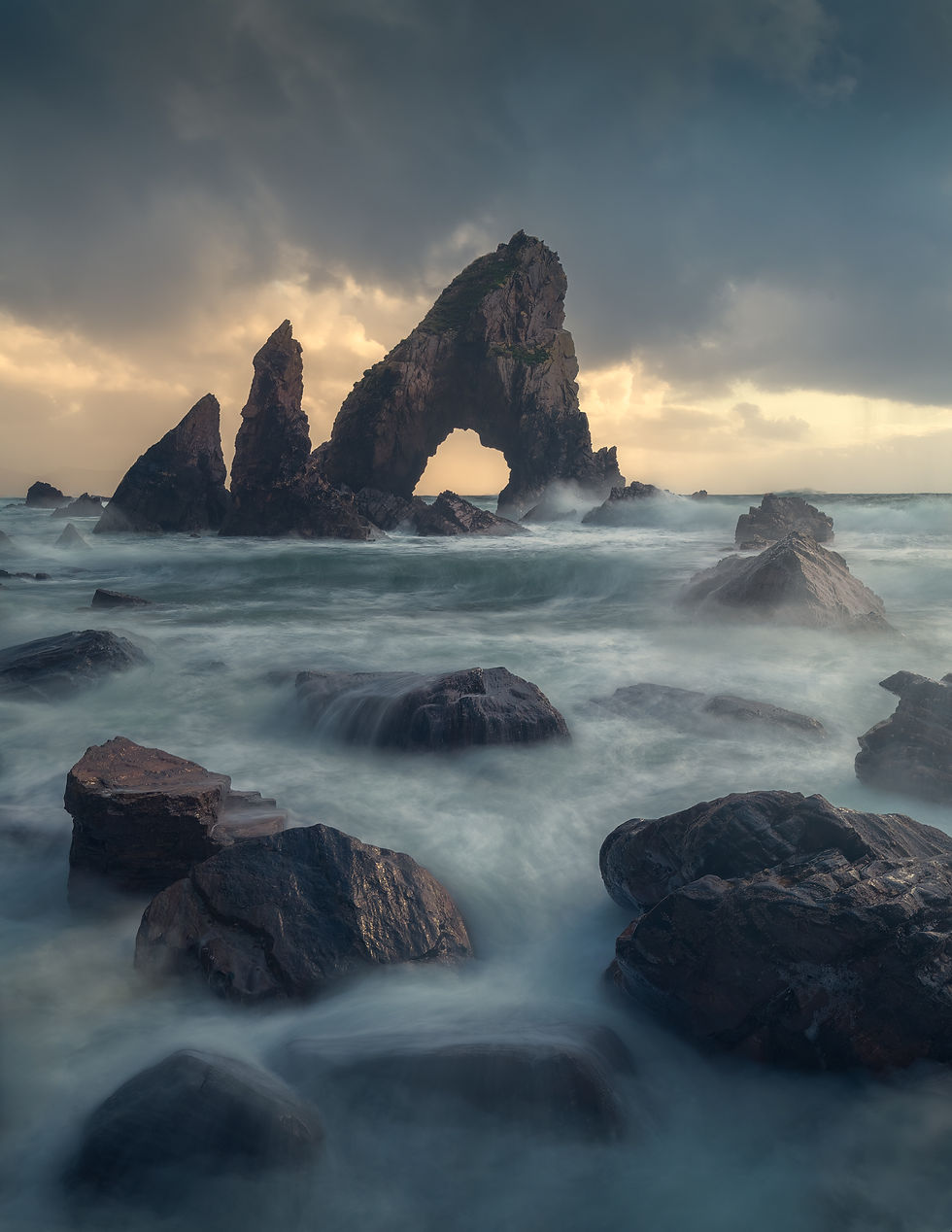
Crohy Head impresses with the striking Bristi Sea Arch, rugged cliffs, and offshore sea stacks—a wild Atlantic setting that looks particularly spectacular in dramatic weather.
There is a small, free lay-by right off the coastal road (54.914251, -8.452161), though the limited spaces fill up quickly; alternatively, you can park in Maghery and walk the remaining kilometer or so.

A short, unmarked grassy path leads from the parking area to the cliff edge in about 10 minutes, offering the best view of the sea arch.
Late afternoon through to sunset is the ideal time for atmospheric landscape photography, as the warm light highlights the rock arch; anyone wishing to descend to the beach should do so only during a safe low tide and in suitable weather conditions.


Comments