
.png)
August 15, 2026 – Amidst half-timbered houses and canals: two days in the heart of Alsace

Part 1 – Colmar: A Fairytale Town Awakens
Even before the first rays of sunlight touch the rooftops, a special stillness envelops Colmar. The narrow streets are deserted, and the facades appear almost surreal in the soft morning light. Here and now, my two-day photographic journey through Alsace begins—camera in hand, always on the lookout for traces of centuries past.


Colmar makes for the perfect starting point. The historic old town looks as if it stepped straight out of a picture book: richly decorated half-timbered houses, colorful facades, small squares, and canals winding through the ancient quarters. It is in the early morning hours that the town reveals its most tranquil side.


In the Petite Venise district—"Little Venice"—houses are reflected in the water. Later in the day, boats glide through the canals while life slowly stirs in the winding alleyways. For photography, Colmar offers a virtually inexhaustible wealth of subjects—ranging from the details of an intricately carved façade to sweeping cityscapes featuring church spires and rows of historic houses.
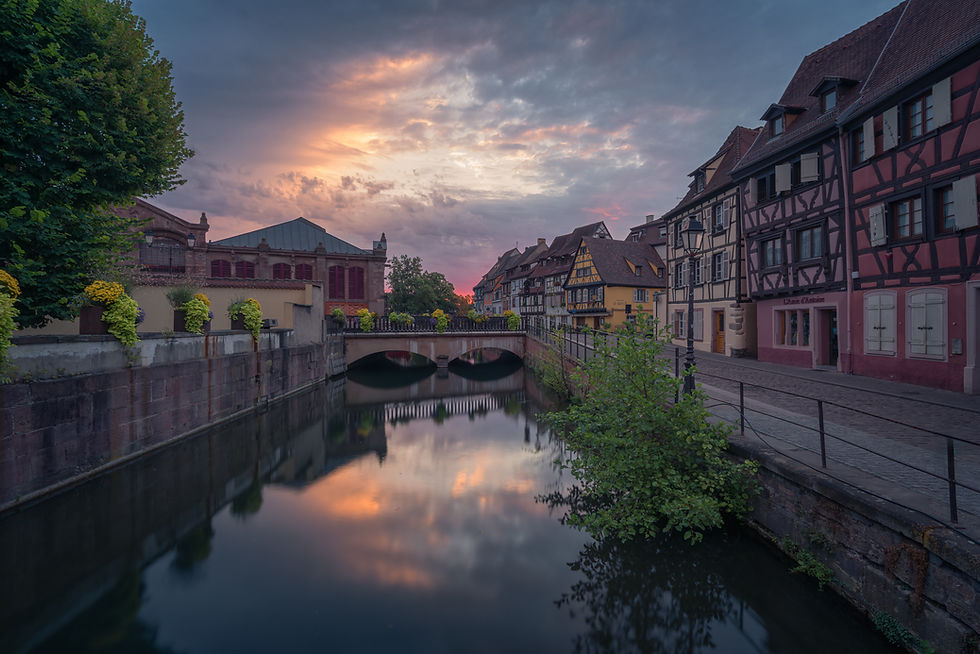

As the day progresses, the atmosphere shifts. The warm morning light gives way to the clearer light of day; visitors fill the streets, and the quiet, fairytale-like town transforms into a lively Alsatian city.


Part 2 – Kaysersberg: Half-timbered houses on the Wine Route
The journey continues to Kaysersberg—located about a 15-minute drive from Colmar—one of the most distinctive towns along the famous Alsatian Wine Route.
High above the historic old town stands the Imperial Castle of Kaysersberg (Château de Kaysersberg), built in the 13th century (around 1200–1227). It once served to control the trade routes leading to Lorraine. It was a key strategic site during the conflict between the Empire and the Dukes of Lorraine.
By climbing the 122 steps to the top of the keep, visitors can enjoy a magnificent panoramic view of Kaysersberg, the valley entrance, the vineyards, and—on a clear day—even the Black Forest in Germany.


The view of the houses along the Weiss River is particularly charming. The combination of water, bridges, and half-timbered architecture creates a picturesque scene that is especially captivating just before and after sunset.
It is the little details that define the town's character: window boxes filled with flowers, old doors, decorative woodwork, irregular stonework, and the varied colors of the facades.


The old town is defined by historic half-timbered houses standing in close succession. Narrow alleys, small passageways, and squares weave between them, constantly revealing new perspectives. Stone and timber facades speak of a long history, making Kaysersberg an ideal destination for architectural photography.


History, architecture, and landscape are closely intertwined here. As the first lights come on in the houses and the alleys gradually grow quieter, Kaysersberg transforms: the historic architecture is accentuated by the warm glow of streetlamps and shop windows—an atmospheric conclusion to a long day of photography.


Part 3 – Riquewihr: A Village from Another Era
The third stop on the journey is Riquewihr—located just a ten-minute drive from Kaysersberg and ranked among the most beautiful villages in France. A single glance at the historic town center creates the impression that time has stood still here.
Within the old town walls, half-timbered houses stand side by side. Colorful facades, stone ground floors, oriel windows, and richly ornamented timber structures create an exceptionally cohesive historical ensemble.
Riquewihr is a place of endless perspectives, especially for photography. A new view awaits around every corner: a narrow alley, an archway, an antique doorway, or a row of house fronts.


The best way to experience the town is to simply wander through it without a fixed destination. The winding alleys themselves become the subject; they draw the eye between the historic houses, creating a sense of spatial depth that looks particularly striking in photographs.
Late in the evening, Riquewihr takes on a completely different atmosphere. The day-trippers have gone, the alleys grow quiet, and the warm glow of the streetlamps makes the historic facades shine. The bustling tourist destination transforms back into a village with a medieval feel—the kind of place you wish you could have all to yourself.


Part 4 – Conclusion
Two days of photography, stretching from early morning to late evening, mean not only a wealth of subjects but, above all, constantly shifting lighting conditions.
Despite their proximity to one another, Colmar, Kaysersberg, and Riquewihr offer distinct photographic experiences.
Colmar delights with its canals, colorful houses, and an almost fairytale-like townscape. Kaysersberg blends historic architecture with the landscape of the Alsace Wine Route. And Riquewihr impresses with its remarkably well-preserved historic townscape and winding alleyways.
After two long days behind the camera, one impression stands out above all: the feeling of having taken a brief journey back in time. From the first light of dawn through the bustle of the day to the final moments of the "blue hour," Alsace constantly reveals a different side of itself.
And perhaps that is precisely the special appeal of this trip: you are not merely photographing old houses and charming streets—you are capturing the atmosphere of a place where history remains visible and palpable to this day.


Comments